p

Monday, October 20, 2008

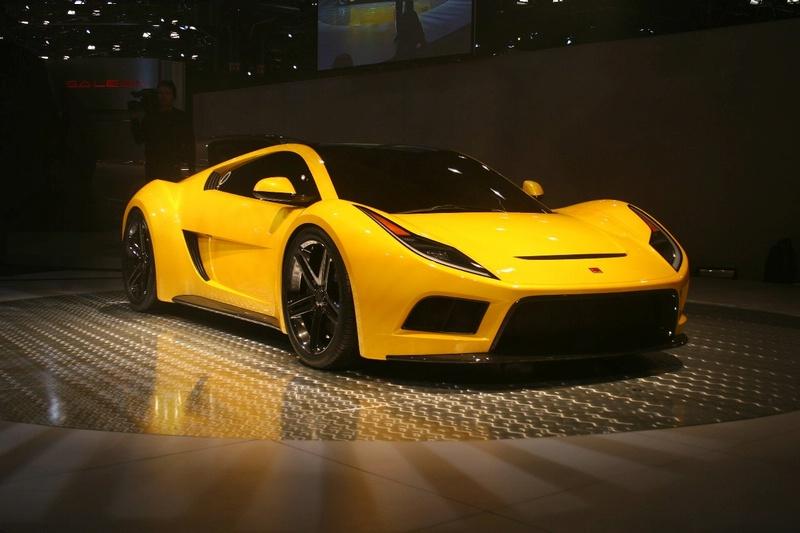
Saleen S5S Raptor Super Car Debut

http://graphics8.nytimes.com/images/2008/03/22/automobiles/600-saleen.jpghttp://www.thesupercars.org/wp-content/uploads/2008/03/saleen-s5s-raptor-concept-4.jpg
At a q
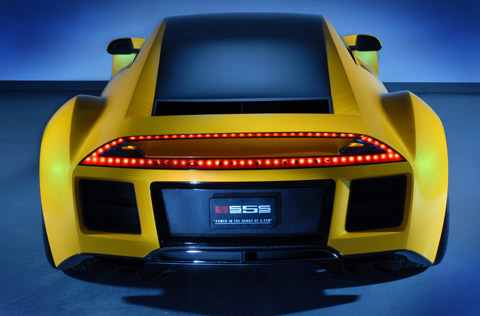
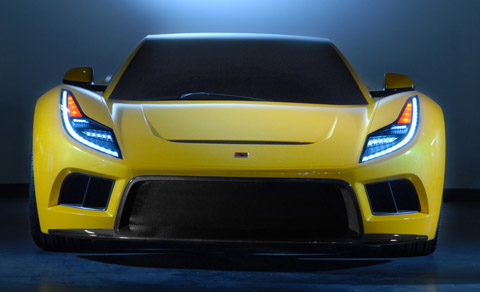
uick glance, you might think this car is Italian a Lamborghini perhaps, or even a Ferrari. This yellow supercar is all-American, however. The Saleen S5S Raptor made its world debut at the New York Auto Show, putting an exclamation point on the specialty manufacturer's recent reinvention of itself.

Considerably more restrained than Saleen's previous supercar the S7, the S5S Raptor features clean lines sculpted in lightweight composites. A solar-tinted glass roof allows daylight in, and the purposeful mid-engine design looks world-class.


Saleen's racing heritage is obvious at the S5S Raptor's heart, a new 5.0 liter supercharged V8. This 650-horsepower, 630 lb-ft torque engine runs on ethanol, just like the IRL and American Le Mans cars, and Saleen reports a 3.2-second 0-60mph time and a top speed of over 200mph. Saleen chose the ethanol burning engine partly as a nod to the track and partly to consider reduced emissions and oil dependence. The engine uses a twin-screw supercharger and is hooked up to a six-speed manual transmission. The Raptor is also designed to handle a paddle-shifted sequential gearbox, if desired.


Double wishbones are used at all four corners, and the massive fifteen-inch front, thirteen-inch rear brakes are augmented by ABS and traction control. The 20-inch forged aluminum wheels have a black diamond and carbon-fiber finish.


That's all very exciting, but it's all just bench talk until the rubber hits the road. Saleen says that the S5S Raptor could be on the road in two years at an estimated $185,000 MSRP, depending on the public's reaction to this car. Saleen seems to have thought this through, so it's a good bet that we'll see a roadgoing Raptor in the near future.
http://www.thesupercars.org/wp-content/uploads/2008/03/saleen-s5s-raptor-concept-2.jpg

http://autoworld.files.wordpress.com/2008/03/saleen_s5s_raptor.jpg


Friday, October 3, 2008

MC 1 Super Car is it possible??

http://longi.org/blog/wp-content/uploads/2008/01/mc1sc5.jpghttp://static.wallpaper.com/images/98_mc1_am21012008_f.jpg


The creators of the design hope to attract the eyes of Ferrari and Aston Martin buyers, this MC1 super car was first unveiled in Germany.


The popularity of Super Cars has increased dramatically over the last decade as personal wealth exploded, with a vehicle that can accelerate from zero to 100km/h in just around 3.0 seconds is not new to the Super Car Industry.


There is one thing that sets the MC1 Super Car apart from any other modern super car, it is the design time of this model. This V10 powered super car was fully designed under 3 months.


The makers wants to prove that super cars don't need years of development, but can be developed just in months.


Some are hesitating about the short turnaround time, and maybe it would change the face of auto industry, but until the production is possible and this car finds a handful of keen buyers,and is built and on the road to be expected by 2011, we will never now.

So is this car even possible to build?


They conducted a survey among their staffs and some like the design but others commented that “it is like a week old garbage”.


The vehicle will feature a mid mounted V10 engine that will output around 450 kilowatts(600hp), and with a light weight carbon fiber body shell it should be one of the fastest super cars ever built with gut wrenching acceleration.


It will have a 20 inch front and wider 21 inch rear wheel rims that is expected to reach around 320km/h (200mph).


The MC1 super car design also features a Lamborghini inspired vertical scissor doors, and measures just over 4.5 meters long, which is fairly short for a modern super car. Until this car is built then we will never know if this type of approach can change the super car industry.


Wednesday, October 1, 2008

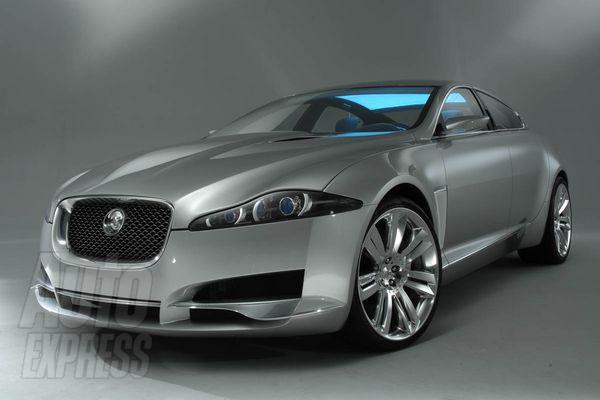
Super Car: Updates on the newest 2010 Jaguar XJ concept

2010 Jaguar XJhttp://www.autoexpress.co.uk/images/front_picture_library_UK/dir_460/car_photo_230274_5.jpghttp://www.autoexpress.co.uk/images/front_picture_library_UK/dir_460/car_photo_230280_5.jpg
2010 Jaguar XJ Hybrid Versionhttp://www.commutefaster.com/JaguarXJhybrid2009.jpg


This is an update version of the newest model of the 2010 Jaguar XJ, the wheelbase will remain virtually identical to the last model, so the improvements will come from mounting the rear seat to lower. All the Major updates will be made to the dashboard, with a facial modeled on the XF.


There will be a revised version of the 3.0 liter V6 and the top model R under the hood. It will be powered by a 500BHP 5.0 liter supercharged V8 engine. The Hybrid version of this car is also in the work. All engines are mated to Jaguar's latest six-speed box, all with complete steering wheel-mounted paddles. The 2010 Jaguar XJ will also have a new damping system similar to Audi's Magnetic ride.


Tuesday, September 30, 2008

Super Car: 2011 Honda NSX super Car

story source: Goauto

This is tipped to be the next-generation Honda NSX.

http://blog.cochesalaventa.com/_fotos/Despite-rumors_-next-Acura-NSX-wont-be-priced-around-_200k2.jpg


The show-stopping Acura Advanced Sports Car Concept, which debuted at this week’s Detroit motor show, is designed to incorporate a powerful front-mounted, rear-drive V10 engine with Honda’s super handling all-wheel drive (SH-AWD), which also underpins the Honda Legend.


Visually, the concept’s exterior demonstrates a dynamic fusion of advanced technology and emotion.

The long, pronounced bonnet features deeply sculpted lines and embossed air vents while the exterior lines run the length of the body, creating a ribbon-like effect from the headlights to the rear wheel arches.


Although modern in its appearance, the car retains the subtle cues associated with its predecessor, the NSX.


The concept’s slim, LED headlights arepushed wide and designed to mimic the pop-up headlights found on the first generation NSX. Other styling hints include a modern take on wraparound rear tail-lights and the all black cockpit.


http://static.blogo.it/autoblog/acura_advanced_sports_concept_03.jpg

"Our intention was to design an exotic sports car that gracefully combines advanced technology and strong emotion," according to Jon Ikeda, principal designer of the Acura Design Center.


"The technical, machined surfaces and keen-edge design are balanced with sweeping curves and dramatic lines, all of which results in the ultimate exotic sports car."


Wide and low to the ground with a 2763mm wheelbase, the concept is anchored by grippe 19-inch front and 20-inch rear performance tires mounted to custom billet-machined, polished aluminum wheels.


Braking is via powerful, ventilated carbon ceramic brakes with eight-piston calipers. Bold wheel arches and flares add to the concept’s aggressive appearance.


The low slung cabin is constructed entirely of tinted glass and sits flush against the body. Door handles are also flush mounted, allowing the sports car to retain a clean and aerodynamic appearance.


The car has a carbon fiber under body and the rear is finished with aggressive quad exhausts and integrated rear diffusers.

Friday, September 26, 2008

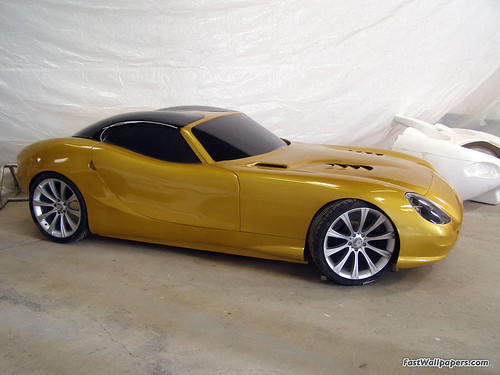
Super Car: Off the chain Trident Iceni

story source: Super Cars

This is the new Trident Iceni. The makers claim that this thing will go beyond 200mph, but even better it will get to an amazing 70 miles per gallon. Do you believe it? No, I’m not so sure that I do either actually.


Unlike almost every other super car built, this one is running on diesel. While many will draw comparisons to the Audi R8 diesel, the Iceni uses a 6.6 liter V8 turbo diesel engine that produces 550bhp and an insane amount of torque – 950lbs per foot. This should be enough to snap your neck, uproot trees or pull ocean liners to shore – whatever your weekend preference is.

Perhaps putting the figures in another way is more meaningful. All that power allows the car to zoom to 60 in just 3.7 seconds, which is as quick as a Ferrari F40. Even better, take it on a long, straight road and you can push it to the 200+ mile per hour top speed.


I’ve no idea if this is true as you’d think that they would then sell it to every diesel manufacturer in the world, but there we are. Amazingly though, it looks as though the claim is true. A recent test at the Mill brook proving ground showed the car returning 69mpg. Even better than this, at town speeds there’s talk of having a range of 2,000 miles on a single tank of diesel.


The body is also pretty impressive. It is made from stainless steel and is guaranteed against corrosion for 100 years. So, what’s not to like? I’ve no idea really. Apparently, the icing on the cake is the price. It weighs in at a not wallet unfriendly £75,000. Well, it’s a good alternative to an Aston Martin right?

Wednesday, September 24, 2008

Super Car: 2008 Bentley Continental GT Speed

Source: Super Car


The 2008 Bentley Continental GT Speed adds more onto the genuine appeal of Bentley’s symbolic GT coupe line, as the car is allowed to reach higher and purer speeds. It was first launched on the 1st of August 2007, and is the most powerful production car Bentley has ever created to achieve optimum speeds with high-end performance. Bentley was inspired to create the car from the ultimate success of the Continental GT coupe, and the renowned Speed models from the iconic era of the 1920s. The result is a beast full of powerful response and handling that keeps the Bentley name in spite of its edgier, hardcore look and feel. It is a complete piece of the Continental series, and a potent piece of machinery.

The Continental GT Speed’s objective was to communicate all the possibilities of its design but still holding firm with everything that made the Continental GT coupe model successful. The exterior design of the new Speed is similar to its predecessor, but has a few subtle variations to it, as it is defined by a chrome matrix grille to assist in the airflow to the more powerful engine. It also has wider and lowly positioned air intakes as well, as the engine needs excellent ventilation. The very vertical grille also helps in intensifying the unique Continental look with a more prominent square edge, plus the new lower bumper positioning that has a wider air intake centrally located to create a very sporting look and hold of the Speed. There are also chromed bezels situated around the headlamps to complete the sporty design. The customer can specify the interiors from a wide range of veneers including Piano Black, and Burr Walnut with diamond quilted hide seats along with embroidered Bentley logo, three spoke multi purpose sports steering wheel, Speed logos on the tread-plates, proposed hide headlining, drilled alloy foot pedals, and a sports alloy gear lever.


The Continental GT Speed carries an impressive 6.0 liter W12 engine that has been improved substantially from its predecessors in the Continental line with aspiration consisting of twin turbochargers. The engine outputs a horsepower of 600bhp (610PS or 449kW), which is a 9% increase from the Continental GT coupe, and a torque of 750Nm (553ft-lb) at 1750rpm, a 15% increase from the coupe. The engine itself is crafted out of light weight components combined with lower friction and a new engine management system, therefore the car optimized its potential and achieved a top speed of 202mph (326km/h). It also achieved acceleration of 0-60mph in 4.3 seconds and 0-100mph in and astounding 10.3 seconds with seamless overtaking performance with 50-70mph in an eye blink of 2.3 seconds.

The car weighed in at 5180lbs with a stiffer, enhanced chassis to make the drive sportier, as the stance of the car became lower with upgraded spring and damper framework, anti roll bars for tauter body control, handling and agility. The alloy wheels that measure 9.5J x 20 is bespoke Pirelli P-Zero high performance tires as standard. The braking system consists of fade resistant carbon ceramic brakes, with modified steering response through revamped speed sensitive Servotronic system on a solid front positioned sub frame and harder rears bushings. The car is also outfitted with extended rifled sports exhaust pipes.

Tuesday, September 23, 2008

US electricar-makers Tesla and Fisker on target to build luxury sedans by late 2010

by: GoAuto

GENERAL MOTORS may have put on the table its plans, pending “satisfactory government incentives”, to produce the world’s first mass-produced electric family sedan in the Chevrolet Volt by late 2010, but some unlikely US rivals have stepped up their campaign to deliver luxury electric sedans in the US before then.

Last week luxury electric car-maker Tesla Motors announced plans to build a $US250 million production facility in the heart of California’s Silicon Valley at San Jose, to manufacture its zero-emissions five-seater luxury sedan, the Model S.

Formerly known as the WhiteStar, the Model S is expected to start being shipped out of the 89-acre site, to where Tesla’s corporate headquarters and research and development centre will be relocated, in late 2010 – when the facility is expected to employ about 1000 workers. Factory construction is due to commence in mid-2009.

Left: Tesla Roadster and Fisker Karma.

President and CEO Ze'ev Drori said Tesla selected the San Jose site, 32km from Tesla’s current HQ in San Carlos, because of its high concentration of skilled engineers and support infrastructure, and to minimise the inconvenience for m
ore than 250 of its current staff.

“Big deals like this happen when both parties have something significant to gain,” said Mr Drori in reference to San Jose mayor Chuck Reed’s 15-year job-creation initiative dubbed ‘Green Vision’.

“Locating Tesla’s headquarters, manufacturing and R&D in San Jose will allow us to proceed with minimum disruptions and virtually no dislocations.

“Clearly, no one would argue that Silicon Valley is the center for electronics and electrical engineering. The heart and soul of the electric car is the electric drivetrain, and for that, we need the type of skills available here.”

Assembly of the current $US109,000 ($A131,000) Tesla Roadster two-seater, 27 of which have so far been delivered in the US and Europe, will remain at the Lotus factory in Hethel, UK and is scheduled to increase to 40 per week by early 2009.

Some 1200 deposits have been taken for the Tesla Roadster, which commenced production in March, while the Model S sedan, which will be powered by a lithium-ion battery pack, is expected to cost about $US60,000 ($A72,000).

Central to the production of both the two-door Tesla Roadster and four-door Model S will be a “final powertrain solution” from US transmission specialist BorgWarner, which was announced two weeks ago.

The new single-speed transmission, which will be retro-fitted to the 27 Tesla Roadsters sold to date free of charge, is claimed to deliver 30 per cent more torque as well as a 10 per cent better travelling range of 355km.

“Last December, when the two-speed transmission designed by a previous supplier proved not to be durable, we announced we would modify our approach,” explained JB Straubel, Tesla’s chief technology officer.

“By using a more powerful inverter and an enhanced motor design, we were able to implement a single-speed gearbox and still achieve our original performance goals. In fact, the new set-up is superior in almost every way.”

The new BorgWarner gearbox is designed to cope with the Roadster’s increased performance, which now includes 380Nm of torque (up from 286Nm with the “interim” transmission). The Tesla Roadster is claimed to accelerate to 100km/h in less than four seconds.

“Successfully implementing the new gearbox in less than a year was an incredible technical challenge and huge accomplishment for Tesla’s engineers,” said Mr Drori.

“Now that we have a final powertrain design, in a matter of months there will be hundreds of Tesla Roadsters across the country. We’re heralding nothing less than a new era of the automobile.”

Meantime, an even newer US-based plug-in hybrid vehicle maker, Fisker Automotive, also announced two weeks ago that it has secured a further $US65 million ($A78 million) in funding, from the Middle East's Qatar Investment Authority.

The Irvine, California-based start-up car-maker, headed by former BMW and Aston Martin designer Henrik Fisker, says it is now on target to produce its Karma EV by the fourth quarter of 2009, with peak production volume of some 1250 vehicles per month due to occur by late 2010.

The 15,000 Karmas Fisker plans to have built annually by Norwegian contractor Valmet will also be bankrolled by Palo Alto investors and Kleiner Perkins, while their electric powertrain was developed by Quantum Fuel Systems Technologies Worldwide, which co-founder Fisker Automotive with Fisker Coachbuild LLC in 2007.

Dubbed Q Drive, the Karma’s drive system is claimed to offer 80 miles of emissions-free motoring if it is charged overnight. Fisker claims to have taken more than 500 deposits since the Karma made is global debut at the 2008 Detroit motor show in January.

“We are extremely pleased to have closed our financing round at this time, particularly in light of the current market conditions,” said Mr Fisker on September 10. “This shows that Fisker Automotive has a solid business plan and a globally experienced automotive team with very strong investors behind the company.”